


Perimenopause fatigue is a real, hormonally driven exhaustion affecting the majority of women in their 40s and 50s. Declining oestrogen and progesterone disrupt sleep, mood, and energy metabolism — but with the right combination of medical and lifestyle support, you can reclaim your vitality.
If you've been sleeping eight hours and still waking up bone tired, or wondering why your energy has simply vanished, you are not imagining things. Fatigue during perimenopause is one of the most common and disruptive symptoms women face in the years before their final period.
Unlike ordinary tiredness, perimenopause fatigue is an unrelenting exhaustion that doesn't respond to rest alone. It can affect your ability to work, care for your family, or enjoy the activities you love. Understanding why it happens is the first step toward feeling like yourself again.
Table of Contents
- What Is Perimenopause?
- Why Perimenopause Causes Such Deep Fatigue
- The Sleep-Fatigue Cycle
- Other Factors That Drain Your Energy
- Lifestyle Strategies to Reclaim Energy
- Medical Treatment Options
- Frequently Asked Questions
- Conclusion
What Is Perimenopause?
Perimenopause is the transitional phase leading up to menopause — confirmed 12 months after your final period. These are distinct stages: perimenopause involves fluctuating, unpredictable hormone levels, while menopause reflects a more stable (lower) hormonal baseline.
The Australasian Menopause Society notes that some women can experience menopausal symptoms for 5–10 years before their final menstrual period, and that the age of onset and duration are not able to be reliably predicted [4]. Perimenopause typically begins in the mid-to-late 40s, though it can start earlier. Your ovaries gradually produce less oestrogen and progesterone, and the erratic swings in these hormones — rather than a simple decline — trigger many symptoms.
Irregular periods, hot flushes, mood swings, night sweats, and fatigue are among the most frequently reported symptoms. Many women are surprised to experience these changes in their early 40s, years before they expect menopause to arrive.
Why Perimenopause Causes Such Deep Fatigue
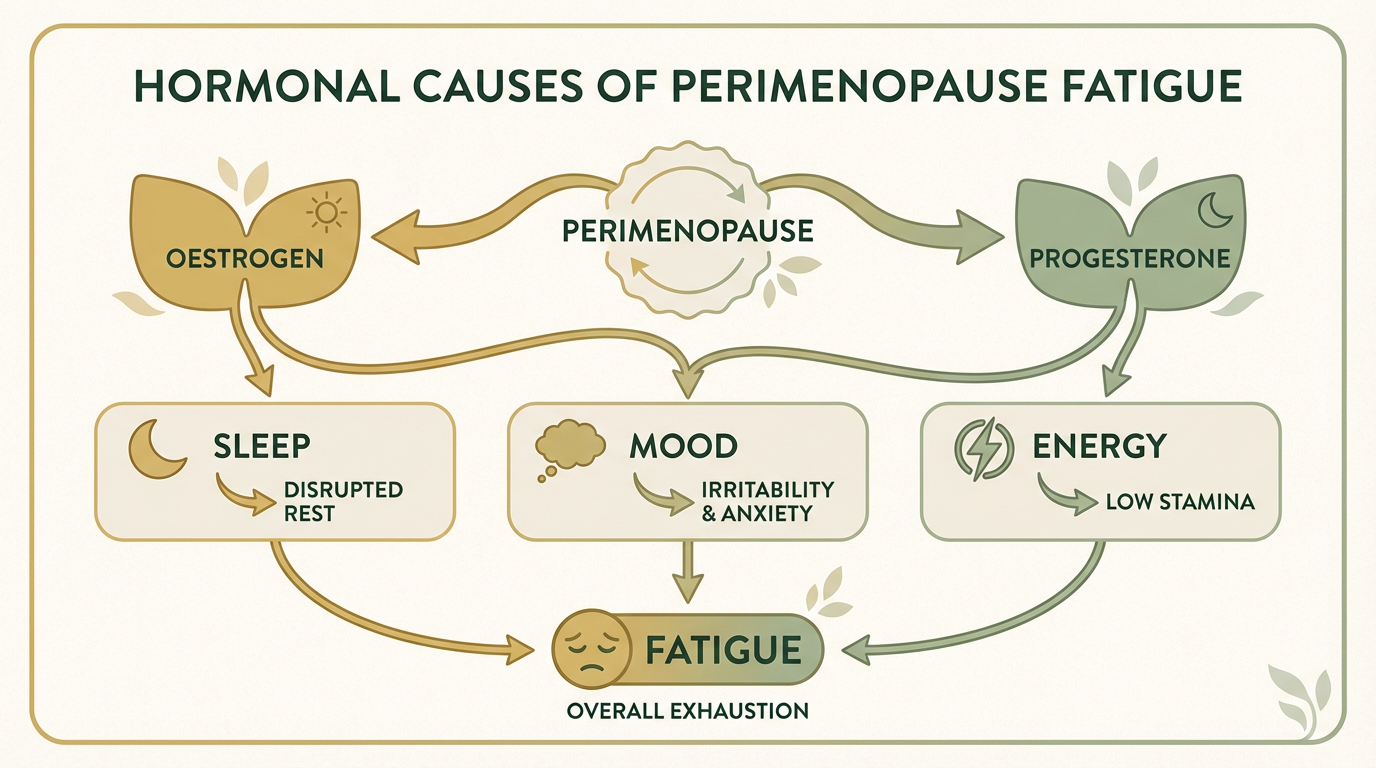
Perimenopause fatigue is not a character flaw. It has clear physiological roots.
Oestrogen, Progesterone, and Brain Energy
Oestrogen plays a key role in brain energy metabolism. Research indicates that declining oestrogen influence on receptor sites may trigger a hypometabolic brain state — meaning your brain is running on less fuel [1]. This manifests as mental fatigue, difficulty concentrating, and that familiar 'brain fog.'
Progesterone has a naturally calming, sleep-supporting effect on the nervous system. As it fluctuates and declines, many women lose its sedative benefits. Both oestrogen and progesterone are positively associated with sleep quality during the menopause transition [1].
What makes perimenopause particularly draining is that the brain must constantly adapt to changing hormone levels. These fluctuations can be more disruptive than a steady decline.
The Cortisol Connection
Hormonal shifts can disrupt the body's stress response, leading to elevated or dysregulated cortisol. This creates a recognisable pattern: exhausted during the day, yet restless and wired at night — a cycle that is difficult to break without targeted support.
Abnormal Bleeding and Iron Loss
A 2025 study published in Menopause — using longitudinal data from 2,329 Study of Women's Health Across the Nation (SWAN) participants — found that three or more episodes of heavy menstrual bleeding in the prior six months were positively associated with feeling tired during the menopause transition [2]. Heavy or prolonged bleeding can also lead to iron deficiency, compounding hormonal exhaustion.
The Sleep-Fatigue Cycle
Sleep disorders are among the most significant — and most under-recognised — drivers of perimenopause fatigue. A 2025 narrative review in the Journal of Clinical Medicine found sleep disorders affect 16–47% of perimenopausal women, rising to 35–60% after menopause [1].
Vasomotor Symptoms and Broken Rest
Hot flushes and night sweats jolt you out of deep, restorative sleep stages overnight. The result is fragmented sleep and daytime exhaustion that accumulates over weeks and months.
The Hidden Issue: Sleep Apnoea
Sleep apnoea becomes more common during perimenopause, and women often present differently — reporting fatigue and mood swings rather than the classic snoring — meaning it frequently goes undiagnosed [1]. If fatigue persists despite other interventions, discussing a sleep study with your doctor is worthwhile.
Mood and the Energy Drain
Anxiety and depression frequently co-occur with perimenopause and amplify fatigue. Research suggests up to 70% of women experience mood disturbances during this transition [3]. When emotional exhaustion compounds physical tiredness, addressing mood alongside sleep is often essential.
Other Factors That Drain Your Energy
Hormones are not the only culprits. Several conditions become more common during perimenopause and can mimic or worsen fatigue:
- Thyroid dysfunction: Hypothyroidism shares many symptoms with perimenopause — low energy, weight gain, brain fog — and the two often occur together in midlife.
- Blood sugar instability: Lower oestrogen can reduce insulin sensitivity, causing afternoon energy slumps and sugar cravings.
- Nutrient deficiencies: Iron, vitamin D, and B vitamins are commonly low in perimenopausal women. Heavy periods increase iron losses.
- Weight gain and metabolic shifts: Changes in fat distribution and metabolic rate affect overall energy and stamina.
Because these conditions are treatable, a thorough blood panel as part of your perimenopause assessment is essential — not optional.
Lifestyle Strategies to Reclaim Energy

Lifestyle changes are a cornerstone of managing perimenopause fatigue — and work best alongside medical support. See our overview of menopause symptoms to better understand what you may be experiencing.
Sleep Hygiene
- Keep a regular sleep and wake time, even on weekends
- Keep your bedroom cool, dark, and quiet
- Limit caffeine after midday and alcohol in the evenings
- Avoid screens for at least an hour before bed
- Consider Cognitive Behavioural Therapy for Insomnia (CBT-I), which research supports as an effective first-line approach [1]
Exercise and Nutrition
Regular physical activity supports sleep, stabilises mood, and improves insulin sensitivity. Strength training is particularly valuable for preserving muscle mass. A 2024 review found yoga and aerobic exercise may help with menopausal symptoms including fatigue, though research on the optimal form is ongoing.
For nutritional support, our naturopaths and nutritionists can help identify deficiencies, address blood sugar stability, and personalise your eating approach — including adequate protein, healthy fats (oily fish, avocado, nuts), and high-fibre carbohydrates.
Stress and Nervous System Support
Practices including mindfulness, breathing exercises, and gentle yoga can help regulate cortisol. Anxiety and chronic stress are major energy drains, and addressing them directly can significantly improve how you feel.
Tip: Track your symptoms over several weeks. Identifying patterns — including sleep, energy, mood, and cycle — gives your healthcare provider invaluable information.
Medical Treatment Options
For many women with moderate to severe fatigue, medical support makes a meaningful difference. See our menopause treatment program for more on the approaches available.
Menopausal Hormone Therapy (MHT)
MHT addresses the underlying hormonal fluctuations driving perimenopause symptoms. Evidence supports MHT for improving sleep disorders, reducing vasomotor symptoms, and supporting mood and quality of life when started at an appropriate time.
Body-identical hormone therapy — using hormones with the same molecular structure as those the body produces — is the preferred approach. Commercially available body-identical options listed in the ARTG (e.g. Prometrium; ARTG 232818/232823) are recommended first-line, with transdermal oestrogen delivery preferred over oral forms (to minimise blood clot risk) and micronised progesterone preferred over synthetic alternatives. Whether MHT is appropriate depends entirely on your individual health history and risk factors — a conversation for your menopause-focused doctor.
Treatment information: Hormone therapy is not suitable for everyone. Your doctor will assess whether it is appropriate for you based on your individual health history, symptoms, and risk factors. Individual results may vary.
A Multidisciplinary Approach
Because perimenopause fatigue has multiple contributing factors — hormonal, nutritional, psychological, and metabolic — an integrated approach produces the best outcomes. A team including a doctor, naturopath, and nutritionist can address each layer.
The Australian Menopause Centre's treatment program brings this team together through telehealth, so women anywhere in Australia can access specialist menopause care without leaving home or needing a referral.
Exhausted and not sure where to start? A menopause-focused doctor can order the right tests, rule out other causes, and build a plan that addresses sleep and hormones. Book a bulk-billed consultation — no referral needed.
Frequently Asked Questions
How long does perimenopause fatigue last?
Perimenopause lasts four to eight years on average, and fatigue often fluctuates throughout this time. For many women, energy improves once hormones stabilise after the final period. With appropriate support, symptoms can often be managed well before that point.
Is perimenopause fatigue different from normal tiredness?
Yes. Normal tiredness responds to rest. Perimenopause fatigue is a persistent exhaustion unresolved by sleep alone, typically accompanied by brain fog, low motivation, mood swings, and physical heaviness — with a direct hormonal cause.
Should I get blood tests for perimenopause fatigue?
A comprehensive assessment is strongly recommended. Blood tests can identify iron deficiency, anaemia, thyroid dysfunction, and vitamin D or B12 deficiency — all common in midlife and treatable. Your doctor will also assess hormone levels in the context of your symptoms.
Can weight gain worsen perimenopause fatigue?
Yes. Hormonal changes shift fat distribution and affect metabolic function. Addressing weight gain through nutrition, exercise, and medical support can improve energy. The Australian Menopause Centre also offers a weight loss program designed for this life stage.
When should I see a doctor?
If fatigue is persistent, worsening, or affecting daily life, seek professional advice — especially if accompanied by chest pain, shortness of breath, severe depression, or lack of concentration. Thyroid disorders and sleep apnoea present similarly and are important to rule out.
Conclusion
Perimenopause fatigue is real, common, and manageable. It has a clear biological basis — hormonal fluctuation, sleep disruption, and interconnected metabolic changes — and it responds to the right support.
The most effective path forward combines personalised medical assessment, evidence-informed lifestyle changes, and body-identical hormone therapy where appropriate and under specialist guidance. You do not need to wait until things become unbearable to seek help.
The Australian Menopause Centre offers bulk-billed telehealth consultations with a multidisciplinary menopause team, accessible from anywhere in Australia, no referral required.
This information is for educational purposes only and is not medical advice. Consult your healthcare provider for personalised recommendations. Treatment decisions should be individualised based on your medical history and circumstances.
References
- Troìa, L., Garassino, M., Volpicelli, A. I., Fornara, A., Libretti, A., Surico, D., & Remorgida, V. (2025). Sleep disturbance and perimenopause: A narrative review. Journal of Clinical Medicine, 14(5), 1479. https://doi.org/10.3390/jcm14051479
- Harlow, S. D., Gold, E. B., Hood, M. M., Mukwege, A. A., Randolph, J. F., & Greendale, G. A. (2025). Abnormal uterine bleeding is associated with fatigue during the menopause transition. Menopause. Advance online publication. https://doi.org/10.1097/GME.0000000000002525
- Okpete, U. E., & Byeon, H. (2025). Optimizing perimenopausal mental health by integrating precision biomarkers, digital health interventions, and psychosocial care. World Journal of Psychiatry, 15(7), 101906. https://doi.org/10.5498/wjp.v15.i7.101906
- Australasian Menopause Society. (2023). What is menopause? Information Sheet. https://www.menopause.org.au/hp/information-sheets/what-is-menopause
